c0nc0rdance

@c0nc0rdance.bsky.social

Molecular biologist from Texas, here to share my meanderings on nature, science, history, politics, and zombies. Long threads a specialty.

The skull of a Flat-tail horned lizard (Phrynosoma mcallii), close relative of the 'Texas horny-toad', native to the Sonoran desert. Unlike the thorny spikes on the body that are made of modified skin keratin, head spikes (horns) are bony skeletal structures covered in keratin. (📷: Emily Chebul)

Flat-tailed Horned Lizard (Phrynosoma mcallii) in Mexico.  The skull has bony spike all over it, but especially near the nostrils and back fringe of the head.
Emily Chebul iNaturality 17229024

Ancient Greek medical texts compared the white milky fluid of the mistletoe berry ('ixos') to sperm ('sperma') which is why they used them in fertility rituals, infertility folk cures. Let's talk about these strange, toxic (hemi)parasitic plants & how they gave us: "viscous". (📷: J Pfeiffer)

An Alamy stock photo of a European mistletoe berry, showing the sticky strings of long polysaccharides.  A pair of human finger contain the seed, goop and outer shell of the white or cream-colored berry.
Photographer: "imageBROKER/J. Pfeiffer"

This unattributed viral video is of divers approaching a school of young barracuda, possibly Sphyraena barracuda, the "great barracuda". They're a misunderstood fish. Ferocious predators known for aggressive behavior, yes, but not a significant threat to human divers, because of how they feed.

One of my favorite things about science is how we will never run out of mysteries and puzzles, and the latest is the "sea of polygons" captured by NASA’s Curiosity rover at Valle Grande on Mars. It could be an interesting clue to how these rocks formed, signs of life or past surface water...

A close-up of the polygon fractures discovered by NASA’s Curiosity Mars rover highlights their honeycomb-like textures
NASA/JPL-Caltech/MSSS

Maybe you've had a cat that liked to nibble on fruit, or enjoy a sweet treat, but I am sorry to say that the research on this is pretty clear: cats can't taste sweet. As with *everything* in science, this is subject to revision with new data. Let's review the existing evidence!

Cute Cat Enjoys Ice Cream Cone

Alt: Cute Cat Enjoys Ice Cream Cone. One of those viral types of gifs in the library. Black and white cat licks a vanilla ice cream cone held by a human hand.

static.klipy.com

Global production of watermelon is between 100-200 million tons/year. This red sweet treat has very deep roots, but it's unclear when it was domesticated to the form we know. A new clue comes from an unlikely place: a 3500 year old Egyptian mummy, combined with some very lucky DNA sequencing.🍉🧪

Cute Cat Eating Watermelon

Alt: Cute Cat Eating Watermelon. It's a viral meme, so I don't know the attribution, but a grey tabby cat with a nice round face take big chomps out of a red watermelon held in a human hand. Cats can't sense the sugar, but may enjoy the water and texture, but should get only a tiny amount to avoid stomach upset.

static.klipy.com

Russian Wikipedia: "Initially, the sound detectors were crewed by ordinary soldiers, which led to predictable results." The military began to employ blind soldiers in this role in 1942. These "Listeners" could detect the direction, distance, altitude, and even type of approaching German planes.

c0nc0rdance@c0nc0rdance.bsky.social · 3d ago

Because radar was a little slow to deploy outside of the US/UK, the Soviets were relying on this device (the ZT-4) well after 1942. You can see more amazing and astoundingly weird images here: www.thevintagenews.com/2016/04/25/v...

Soviet soldiers are listening to the sky with their ZT-4 locator, 1942

Let's explore a specific moment in time: BEFORE radar was invented (~1939) but AFTER airplanes entered warfare (1911). The best way to detect an airplane sneaking up on your border or coastline is with one of these absolutely ridiculous-looking devices. This is a "two horn acoustic locator", 1921.

A two-horn listening device in use at Bolling Field in Washington, D.C., in 1921, used to detect distant aircraft before the advent of radar.

Apollo 14 launched on Jan 31st, 1971 containing about 500 tree seeds (and also 3 human astronauts, for ballast, one presumes). These tree seeds were bold pioneers: Earthling visitors to our nearest neighbor in space. They returned to Earth & were planted across the country. MOON TREES!

What in the World Are Moon Trees? - NASA Science

Fifty years ago, the Apollo astronauts carried some souvenirs from Earth to the Moon, and then brought them back.

science.nasa.gov

Magical video by Mike Nulty (@nuttynulty on IG) of a whale shark (Rhincodon typus) off the coast of Baja, swimming through reflective plankton or debris that look like stars. Space whale-shark! 🦈✨ Let's talk about /actual/ glowing sharks, the lantern sharks of family Etmopteridae. (📷: Mike Nulty)

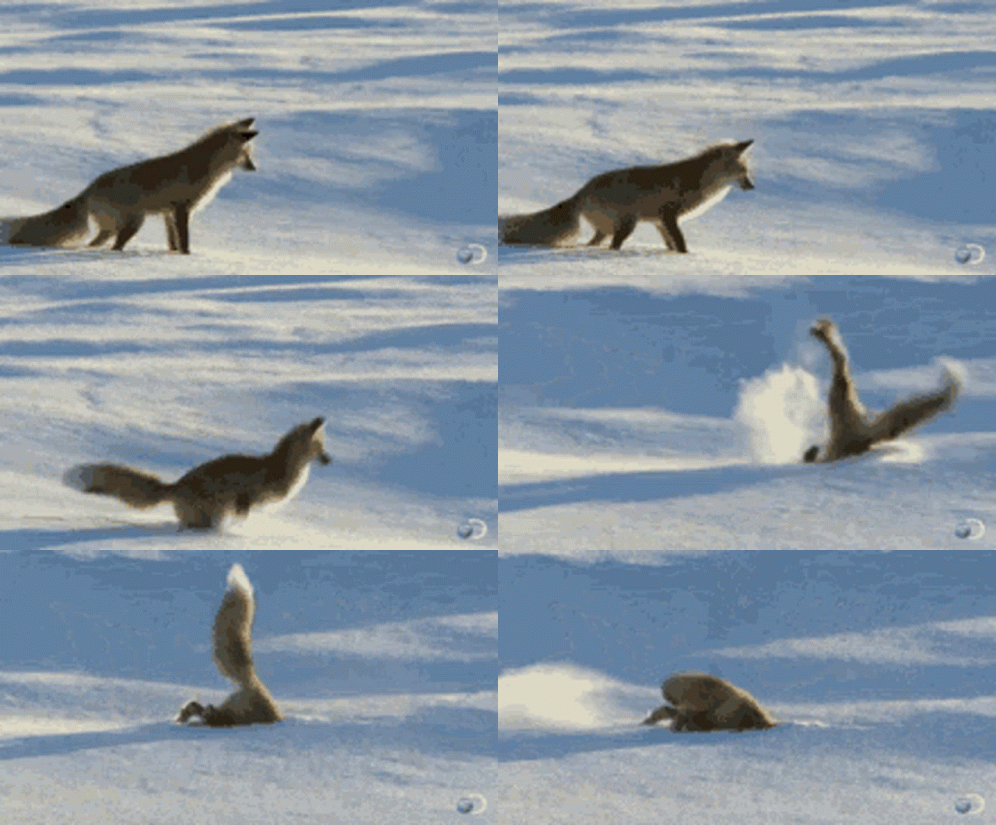
This may look like a FOX FAIL, but it's actually what these animals were finely tuned by evolution to do. You're looking at a master of "mousing". The fox cocks its head, pinpointing the telltale rustle under the snow of a rodent burrowing. But it doesn't waste time digging. It goes head-first.

a fox standing in a snowy field with a blue sky in the background

Alt: A red/orange fox with white tipped tail standing in a snowy field with a blue sky in the background. It cocks its head, then suddenly leaps face-first into the snow, tail comically left in the air.

media.tenor.com

ALMOST EVERYTHING about penguins is cute. There is *one exception*: they are champion poop producers. Specifically, they would win the long-distance contest. Humboldt penguins can propel poop well over twice their own height (picture is unrelated). Warning: thread contains penguin defecation.

a group of penguins standing on top of a pile of ice .

Alt: a group of penguins standing on top of a pile of ice . One suddenly steps on thin ice and faceplants into soft spot, disappearing beneath the water.

media.tenor.com

Thousands of ocelots (Leopardus pardalis) once roamed Texas, but urban sprawl, the rise of ranching & the clearing of thornscrub forest biomes for cattle have depleted their numbers to ~100-150 left. This Texas research institute aims to change that, if Elon Musk doesn't stop them.

Baby Ocelot Yawns and Meows

Alt: Baby Ocelot Yawns and Meows. A pair of gloved hands holds an ocelot, a sort of kitten-sized cat with yellow and white fur with black stripes. It is ridiculously cute and I want to hug it so much it hurts.

static.klipy.com

The headlines are still covering the cyclosporiasis outbreak from lettuce, but let's talk about a different summer, long ago. The headlines in Bavaria would have called it "summer diarrhea" & it was killing babies. Enter our hero, Professor Theodor Escherich of the Julius Hospital, Würzburg.

Signed portrait of Theodor Escherich, MD (1857-1911). Dr. Escherich was a German-Austrian pediatrician, best known for his discovery of the Escherichia coli bacterium