The Annual Meeting 2026 draws to a close and we’re looking back on an inspiring week! 🐾 Thank you to all speakers, presenters, participants and everyone who made this 100th anniversary meeting so special! 🎉 @mfnberlin.bsky.social #DGS2026 #Mammalogy #MammalianBiology
John Nyakatura
@johnnyakatura.bsky.social
Biologist at Humboldt University, Berlin... Zoology, Functional Morphology, Comparative Anatomy, Biomechanics, Evolutionary Biology, etc. Follow this profile for any news from our lab.
Between presentations and conversations, participants at the HFSP Frontier Workshop are exploring how fossils, AI, robotics and computational science can advance our understanding of evolution. #HFSP #HFSPFrontierWorkshop #Evolution #AI #sts 🧪
Thank you for inviting me to speak and for three very inspiring days at the @hfspo.bsky.social #HFSPFrontierWorkshop in London!
What happens when researchers from #paleontology, #AI, #mathematics, and evolutionary #biology come together? New ideas emerge! A glimpse from the #HFSPFrontierWorkshop in London, where scientists are exploring fresh perspectives on the history of life! 🧪 #HFSP #sts
That was fun. @aperegrination.bsky.social please join us as often as you like. I am also looking forward to push our FEA project further ahead 🤩
Last PhD conference: SEB @sebiology.bsky.social in Florence. Had a great time alongside @johnnyakatura.bsky.social's lab! John also presented a great poster on our FEA project with Lisa Kean, in collaboration with Jordi @featunning.bsky.social Bonus: the Pisa natural history museum was incredible 🐳
@johnnyakatura.bsky.social presents how #XROMM scientific rotoscoping allows us to compare kinematics across species and even infer fossils movements @europexn.bsky.social #SEBconference
Finally out! Trabecular structure in tamarins changes depending on their leaping distance! A collaboration with U. Nguyen, @fabioalfieri2.bsky.social, A. Licht and @johnnyakatura.bsky.social, using my #R package "indianabones". (1/2) #primates #BioAnth #bones #science 🧪🐒🦴🏺 doi.org/10.1002/ajpa...
New paper out! 🦴🐒 In the trabecular bone of tamarin limbs, we found that beyond non-locomotor factors, leaping distance leaves a signal! Thanks to @aveneziano.bsky.social, and colleagues from the lab led by @johnnyakatura.bsky.social Open Access on American Journal of Biological Anthropology
Finally out. More of our work on tamarins 🤩. Whole‐Epiphysis Trabecular Bone in Tamarin Limbs Suggests Effects of Leaping Distance Alongside Non‐Biomechanical Factors - Nguyen et al. - 2026 - American Journal of Biological Anthropology - onlinelibrary.wiley.com/doi/10.1002/...
Whole‐Epiphysis Trabecular Bone in Tamarin Limbs Suggests Effects of Leaping Distance Alongside Non‐Biomechanical Factors
Objectives Beyond non-biomechanical factors, the trabecular architecture of long bone epiphyses variably underlies functional adaptations to locomotor behavior. A recent study, characterizing tamari.....
onlinelibrary.wiley.com
Our work on mammalian hallucal grasping, led by Irene Montañez-Rivera during her time in the @johnnyakatura.bsky.social group, is out now in iScience. A true team effort; thanks to the whole crew for inviting me to contribute a small piece! www.cell.com/iscience/ful...
Very proud of the first paper of the PhD project of Adrian Scheidt.
@johnnyakatura.bsky.social et al., investigate the scaling of internal joint distance (IJD), a surrogate measure for cartilage thickness, across small- to medium-sized mammals. Elbow position had no significant effect on IJD and used these data to model the range of motion (ROM) at the elbow joint
2 PhD Opportunities! 🤩 We are recruiting two highly motivated PhD students to join an ambitious project advancing Robotic Paleontology—a rapidly emerging field that fuses paleontology, biomechanics, simulation, and robotics. nyakaturalab.com/news/ Please share!!
Nyakatura-Lab for Comparative Zoology | News
See what’s been happening in the Nyakatura Lab. News: discover our latest publications, recent events, and research highlights.
nyakaturalab.com
I’m very happy to share that our work on bone inner structure of Madagascar’s subfossil sloth- and koala-lemurs is finally out 🦴🐒 on @zoojlinnsoc.bsky.social A big thank you to co-authors @julsam.bsky.social Carla Argilés Esturgó and Damiano Marchi! academic.oup.com/zoolinnean/a... 1/6
The locomotor behaviour of subfossil Malagasy sloth-lemurs (Strepsirrhini: Indriidae) and koala-lemurs (Strepsirrhini: Megaladapidae): new insights from limb trabecular bone
Abstract. The locomotion of Malagasy Quaternary subfossil lemurs, including palaeopropithecines (‘sloth-lemurs’) and megaladapids (‘koala-lemurs’), has bee
academic.oup.com
Cool new insights into some weird fossil mammals from Madagascar 😎 locomotor behaviour of subfossil Malagasy sloth-lemurs (Strepsirrhini: Indriidae) and koala-lemurs (Strepsirrhini: Megaladapidae): new insights from limb trabecular bone url: academic.oup.com/zoolinnean/a...
The locomotor behaviour of subfossil Malagasy sloth-lemurs (Strepsirrhini: Indriidae) and koala-lemurs (Strepsirrhini: Megaladapidae): new insights from limb trabecular bone
Abstract. The locomotion of Malagasy Quaternary subfossil lemurs, including palaeopropithecines (‘sloth-lemurs’) and megaladapids (‘koala-lemurs’), has bee
academic.oup.com
🛡 Natural history of the animal kingdom for the use of young people Brighton: E. & J.B. Young and Co., 1889. [Source]
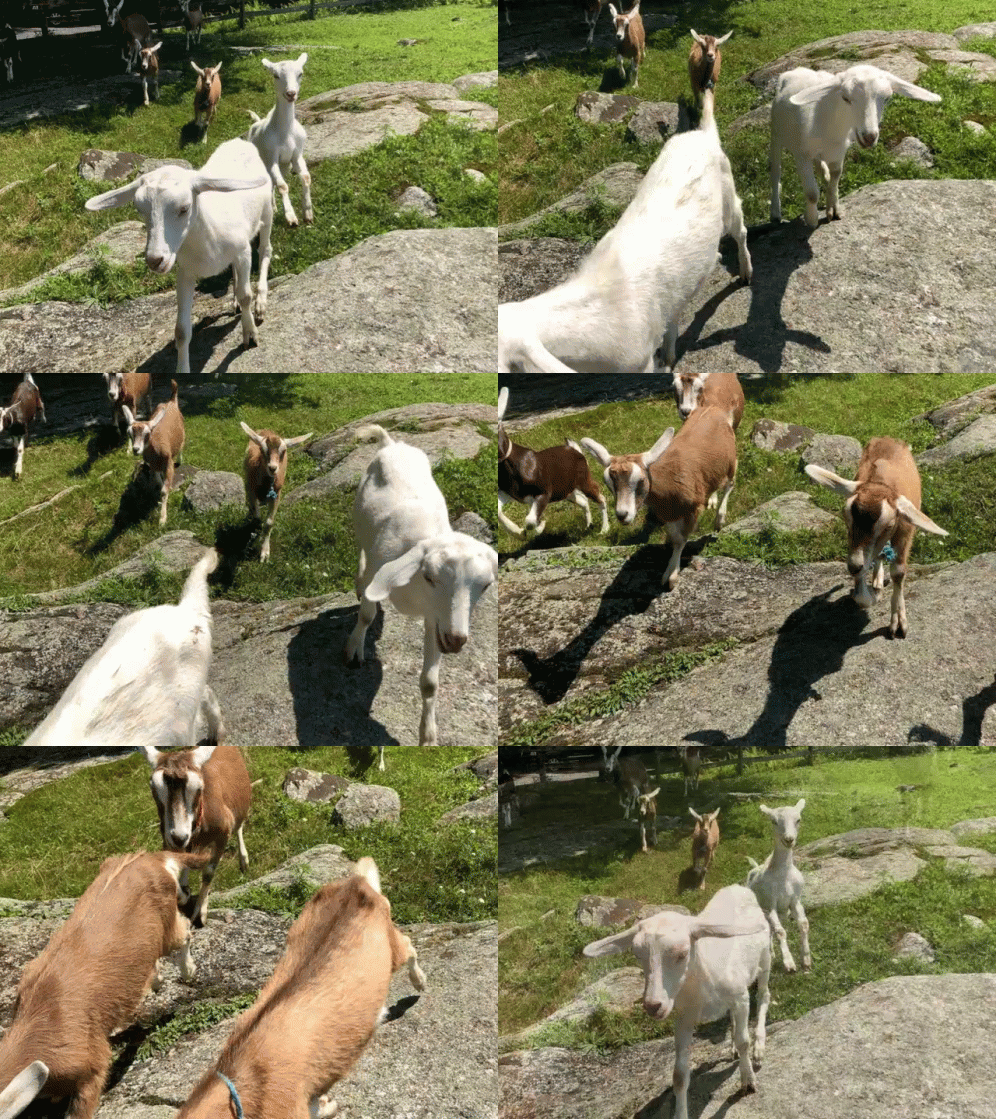
I don't think that the reviewers asking me for higher animal numbers really understand how many 40 goats are. Do you know the CHAOS that comes with dealing with 40 GOATS in an experimental setting! Mice people cannot comprehend. 3 goats alone ate a tarp, a clock, and 2 expensive accelerometers!
a group of goats standing in a grassy field looking at the camera
Alt: a group of goats running towards the camera
media.tenor.com
Comparisons of climbing behaviors in arboreal mammals indicate that adaptations for vertical descent, including upright postures, played a key role in early primate evolution. doi.org/hbppbb
Climbing behaviors of tree-dwelling mammals unlock insights on early primate evolution
Researchers have shed new light on the features that enable tree-dwelling mammals to move effectively through their environments, providing insights into the evolution of the distinct upright postures seen in primates.
phys.org
Our paper, based on a uniquely large dataset of vertical descent behaviours in arboreal mammals, is published in @elife.bsky.social. The findings offer fresh perspectives on reconstructing postures in early primates. You can find the accompanying press release here: elifesciences.org/for-the-pres...
Climbing behaviours of tree-dwelling critters unlock insights on early primate evolution
Researchers have published the first comparative analysis of downward climbing behaviours across a broad range of small mammal species, with insights into the evolution of primates’ arboreal upright p...
elifesciences.org
Happy to share our last article just published in eLife 😁 @johnnyakatura.bsky.social
Scaling of internal joint distance in the elbow of small‐ to medium‐sized mammals: Implications for range of motion analyses - Scheidt - Journal of Anatomy - Wiley Online Library onlinelibrary.wiley.com/doi/10.1111/...
Scaling of internal joint distance in the elbow of small‐ to medium‐sized mammals: Implications for range of motion analyses
We investigated the internal joint distances (IJDs) of the humero-ulnar and humero-radial joint, within a sample of 15 small- to medium-sized mammals and report isometric results. We also found that ...
onlinelibrary.wiley.com
Biomechanical and energetic considerations indicate that the giant extinct seabird Pelagornis could not feed like a skimmer: royalsocietypublishing.org/rsos/article... 🪶🧪 (📷Hellyer-Price et al.)
After teaching my motor control lecture, I was pleasantly surprised to run into some Muybridge originals at the Birmingham Museum of art (for free)! Before his photos in 1878, we didn't know how horses galloped because it was too fast to capture, which is why they look so odd in old paintings! 🧪
Our latest paper is just out 🤩! If you enjoy functional morphology and comparative biomechanics, Adrian's work on the internal joint spacing and its implications for modelling range of motion in the joints of mammals, will be something for you. Cheers! onlinelibrary.wiley.com/doi/10.1111/...
Scaling of internal joint distance in the elbow of small‐ to medium‐sized mammals: Implications for range of motion analyses
We investigated the internal joint distances (IJDs) of the humero-ulnar and humero-radial joint, within a sample of 15 small- to medium-sized mammals and report isometric results. We also found that ...
onlinelibrary.wiley.com
More info on our recent paper in this interview in Science... Why does biology keep building things out of tiles? | Science | AAAS www.science.org/content/arti...
Why does biology keep building things out of tiles?
Science talks with two scientists about finding the beauty in nature’s mosaics
science.org
Thrilled our multi-year work on biological tilings is out in @pnasnexus.org! From virus shells to dinosaurs, seeds to fish scales—tilings are everywhere in biology. Explore the paper and our interactive catalogue (link following in next post): doi.org/10.1093/pnas...
Tiled material systems: Exploring biodiversity and multifunctionality of a universal and structural motif
Abstract. Humans are drawn to patterns and hierarchies in nature, mimicking them particularly in decoration and architecture. Natural patterns, however, ar
doi.org
🚨 Final Call! Don't miss your last chance to submit a poster abstract for the Annual Meeting of the German Zoological Society 🦎🐦🧬 Contribute your research, connect with colleagues — and be part of it! Submission closes tomorrow. Be there or be square!
Journal of Zoology is now on Bluesky! Follow us to discover what we've published recently in our scientific journal covering all areas of #zoology - and find out more about us at zslpublications.onlinelibrary.wiley.com/journal/1469... @zslscience.bsky.social
Our paper reviewing the neurophysiology of swallowing just came out! We detail 70 years of progress towards understanding neuromotor functioning in feeding, and highlight several emerging technologies for the future Check it out at the link below - journals.physiology.org/doi/full/10....
Abstracts due today! Join us in Berlin to explore the full spectrum of zoological research. Expect excellent speakers, an unforgettable evening beneath iconic dinosaur exhibits, engaging city excursions, satellite symposia etc.. Limited slots remain for talks and posters—submit yours now. #DZG2025
👋 Looking forward to the 117th Annual Meeting of the German Zoological Society. Please like and share 🤩
Whoop whoop!
🚀 Exciting news! Registrations for #DZG2025 are rolling in! 🤩 Don't miss your chance to join the Annual Meeting of the German Zoological Society in Berlin. Abstracts are due soon! 🌍 Conference language? English, of course! #Science #Networking #Zoology #ShareAndLike
Gentle reminder: #DZG2025 in Berlin! The extended Early Bird registration is ending soon. Nab the reduced rate NOW and join us in Berlin. 🤩 dzg-meeting.de