Benjamin Kraemer

@limnobenja.bsky.social

Global Change Aquatic Scientist | Grew up in USA, lives in Germany, misses Tanzania | sites.google.com/view/benjaminkraemer/home

Registration is open for the 2026 Global Lake Ecological Observatory Network (GLEON) All-Hands’ Meeting taking place at Lake Banyoles, Spain from August 30 - September 4, 2026! Participation support for students/ECRs is available through the Freshwater Futures Fellowship (deadline April 24). 🌎🌍🌏

Bild

After two years of focusing my aquatic ecology class almost entirely on lakes, I’m excited to expand into stream ecology this year. We will compare and contrast depth gradients in lakes with elevation gradients in a nearby stream which climbs from 312 m to 659 m, all within just 3 km of campus.

Bild

Here's why you'll want to be there: 💧Inspiring speakers: Prof. Dr. Julia Knapp and Dr. Joachim Rozemeijer 💧Two full days of oral and poster presentations 💧Excursion (tentative) to our Ecosense field site 💧Potential for a community paper 📢Spread the word! We look forward to seeing you!

K051 (my “event number”, the unique identifier for each science project) made it to Antarctica! Flew on a C17, only delayed by an hour, too. Thanks US Air Force and Antarctica NZ, now the fun begins. 🧪🦑🦊🦉🌎

Five people bundled up in cold weather gear stand on the ice in front of a military cargo plane, in Antarctica

Analog US spy satellite images from the 1960s are revealing unexpected surprises—this time, it's penguin poop! So, what does the poop tell us in our latest preprint? Work lead by Martynas Bielinis, @drmichellelarue.bsky.social, myself, and Catalina Munteanu

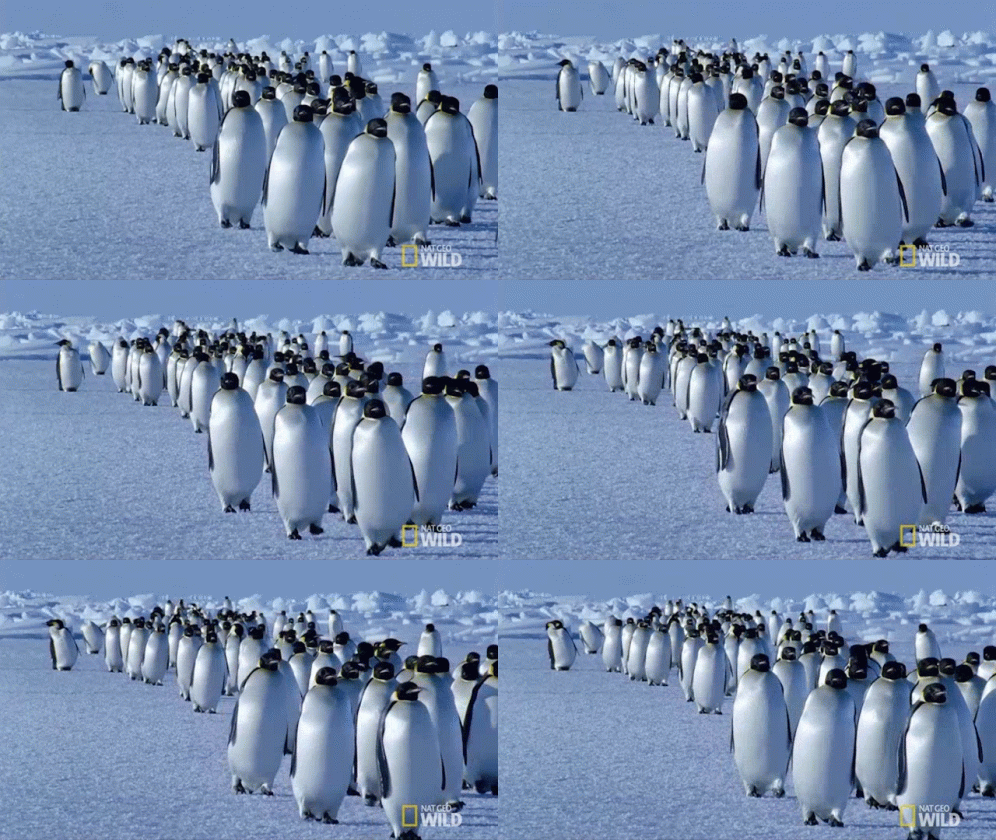
a large flock of penguins are walking in the snow with national geographic wild written on the bottom right

ALT: a large flock of penguins are walking in the snow with national geographic wild written on the bottom right

media.tenor.com

"Absolute teaching bliss" ☺️ is sending two bachelors students in a kayak to collect the first ecological data in over 70 years from a lake so protected, swimming and boating are off-limits. With special permission granted, they’re experiencing something virtually no living human has experienced.🚣‍♀️⛰️🌊

Find us at EGU 🤓 I will talk about our paper published today on the hidden threat of forest dieback to drinking water quality 🍂💙

@hydrofreiburg.bsky.social · last yr.

Excited to share our research at this year’s #EGU25 next week— from forest water fluxes to flood mapping and groundwater stressors. Thanks to @carowinter.bsky.social for pulling together our schedule! Come find us if you’re curious, collaborative, or just passing by.

📌 Monday

Heinke Paulsen | Storage and redistribution of water in the forest floor... (Poster, X3, 10:45–12:30)

Jonas Pyschik | Insights into Preferential Flow from Sprinkling Experiments (Poster, Hall A, 10:45–12:30)

Immanuel Frenzel | Diffuse sources of TFA at the catchment scale (Poster, Hall A, 14:00–15:45)

Lea Dedden | Spatio-temporal throughfall patterns in forests (Poster, Hall A, 14:00–15:45)

Carolin Winter | Forest Dieback & Drinking Water Quality (Oral Highlight, R 2.15, 17:50–18:00)

📌 Tuesday

Sebastian Gnann | Large sample hydrology and the value of data (Invited PICO, Spot A, 08:30–08:40)

Markus Weiler | The crux with variability (Oral, R -2.33, 17:40–17:50)

📌 Wednesday

Sebastian Gnann | Streamflow sensitivity in alpine catchments (Poster, Hall A, 08:30–10:15)

📌 Thursday

Markus Weiler | Flood source areas & peak contribution (Oral, Room B, 16:45–16:55)

📌 Friday

Heinke Paulsen (with Christoph Huebner) | Monitoring groundwater recharge & DOC (Poster, Hall A, 10:45–12:30)

Kerstin Stahl (with Robin Schwemmle) | Groundwater stressors from agriculture & hydrology (Poster, Hall A, 10:45–12:30)

Stefan Seeger | How many sensors do you need for sap flux? (Oral, R 2.44, 11:50–12:00)