
@jwejeglinski.bsky.social What a fabulous talk that was!! I hope we can catch up at the conference tomorrow - if not on the birding tour this afternoon.
Dr. Stephanie Avery-Gomm
@saverygo.bsky.social
Conservation scientist | #seabirds #cumulativeeffects #decisionscience #HPAI #scicomm | https://stephanieaverygomm.weebly.com/
@jwejeglinski.bsky.social What a fabulous talk that was!! I hope we can catch up at the conference tomorrow - if not on the birding tour this afternoon.
Has anyone else let a career milestone slip by quietly? Let's hear about it! 🧪
Dr. Stephanie Avery-Gomm@saverygo.bsky.social · last yr.I recently realized I’ve crossed a milestone I almost missed: 50 peer-reviewed publications! 📑📑📑📑📑 This milestone crept up slowly, quietly, in between drafts and revisions and collaborations — and if I’m honest, I nearly talked myself out of acknowledging it at all. 🤷♀️
I recently realized I’ve crossed a milestone I almost missed: 50 peer-reviewed publications! 📑📑📑📑📑 This milestone crept up slowly, quietly, in between drafts and revisions and collaborations — and if I’m honest, I nearly talked myself out of acknowledging it at all. 🤷♀️

Just read the article "What Do We Do About John James Audubon?", after attending an event by the same name hosted by @fieldinclusive.bsky.social . I highly recommend checking out the article and event recording: www.audubon.org/magazine/spr... www.youtube.com/watch?v=ZTI5... 🪶

What Do We Do About John James Audubon?
The founding father of American birding soared on the wings of white privilege. The birding community and organizations that bear his name must grapple with this racist legacy to create a more just...
audubon.org

Avian flu has had devastating consequences on many seabird populations, but after disastrous breeding seasons in 2022-2023, Roseate Terns on Coquet island, UK, produced more chicks in 2024 than ever before. Good news for one of our rarest seabirds. www.rarebirdalert.co.uk/v2/Content/C...

Coquet's Roseate Terns bounce back after devasting avian flu deaths
A colony of one of the UK’s rarest breeding seabirds, devastated by Avian Influenza in 2022 and 2023 has produced more chicks than ever before
rarebirdalert.co.uk

We humbly interrupt your scroll to bring you the news that Wisdom—the world's oldest known wild bird—is breeding again, age 74. Go on girl. 😍


Skúgvoy seabird populations: Fulmar -89% Kittiwake -87% Arctic skua -84% since 2001! #seabirds and all these species are legal to hunt year roynd 🧪🌍
Dr Sjúrður Hammer@sjurdur.bsky.social · 2y agoHappy to share this quite monumental paper on the birdlife of my favorite island in the whole world - Skúgvoy or "skua island" Long story short, seabird declines are drastic and accelerating. Terrestrial bird populations are generally more stable. #seabirds 🧪🌍 www.tandfonline.com/doi/full/10....
The devastating toll of H5N1 on wild birds is hard to fathom, and sadly, they're not alone. Honoured to contribute to this @nytimes.com story alongside colleagues* working to understand this crisis. www.nytimes.com/2024/12/13/s... * @duckswabber.bsky.social @johannaharvey.bsky.social

For Wild Animals, the Bird Flu Disaster Is Already Here
Scientists are concerned that the H5N1 virus could set off another human pandemic. But it is already putting species under pressure in the wild.
nytimes.com
🚨 New research alert! 🚨 Can citizen science platforms like #iNaturalist help monitor wildlife disease and mortality? Our new study, published in #Ecosphere, uses the massive 2022 #avianflu outbreak in eastern Canada as a case study! 🦅https://doi.org/10.1002/ecs2.70051

This research offers a deep dive into the effects on #Newfoundland #seabirds, but for the regional picture, check the study that summarizes what we know of the 2022 #HPAI mortality event in Eastern Canada! esajournals.onlinelibrary.wiley.com/doi/10.1002/...
Dr. Stephanie Avery-Gomm@saverygo.bsky.social · 2y ago🚨 New research alert! 🚨 Our paper on the devastating effects of the 2022 highly pathogenic avian influenza (HPAI) H5N1 outbreak on Newfoundland seabirds has just been published in @cdnsciencepub.bsky.social 🪶 Dive into McPhail et al., 2024 here: doi.org/10.1139/cjz-...
🚨 New research alert! 🚨 Our paper on the devastating effects of the 2022 highly pathogenic avian influenza (HPAI) H5N1 outbreak on Newfoundland seabirds has just been published in @cdnsciencepub.bsky.social 🪶 Dive into McPhail et al., 2024 here: doi.org/10.1139/cjz-...
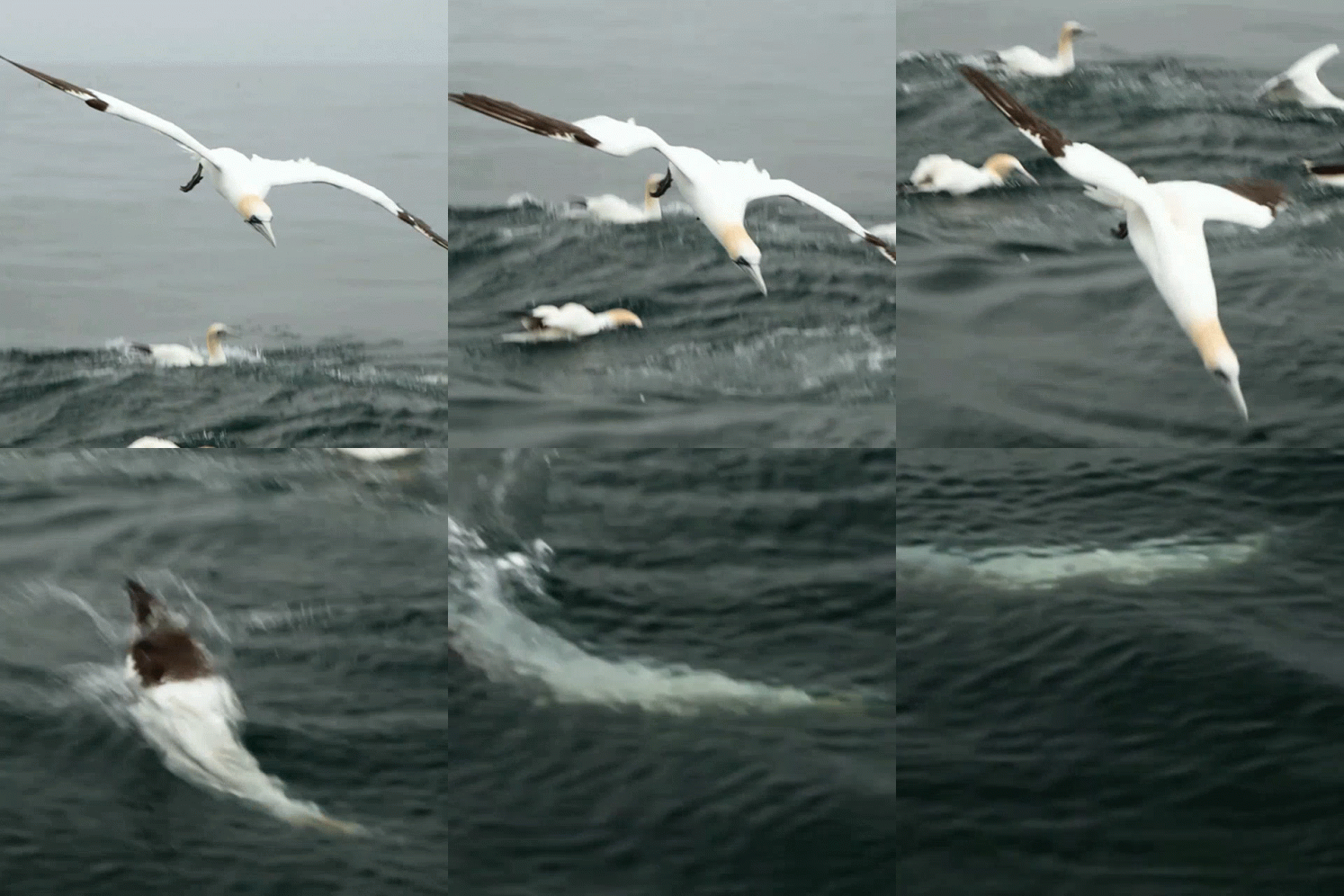
a seagull is flying over a body of water with a duck in the background
ALT: a seagull is flying over a body of water with a duck in the background
media.tenor.com

Morning welcome to Super Seabird Sunday where we ask you to share videos, photos & artwork of Seabirds to brighten up the day. Here is my contribution…those inquisitive Puffins of the Isle of May #SuperSeabirdSunday #Seabirds

To kick-start Bluesky, search for feeds + starter packs on topics you're interested in. I've got this feed with 2800 scientists who study climate + 8 starter packs on climate-related topics. Use SkyFollowerBridge to find your X follows + BlueArk to move your tweets over. bsky.app/profile/did:...

A question: Are "Community Science" and "Citizen Science" interchangeable? What country are you from? I'm hungry for a global perspective. I've heard arguments that 'Community Science" is more inclusive, but only among US colleagues. #ornithology @eBird @iNaturalist
It's finally out! Our work documenting the global spread, clinical signs and demographic consequences of #birdflu in Northern Gannet is available in IBIS Journal onlinelibrary.wiley.com/doi/10.1111/... HT Jude Lane who led the effort!#seabird #HPAI
https://onlinelibrary.wiley.com/doi/10.1111/ibi.13275
Wiley Online Library requires cookies for authentication and use of other site features; therefore, cookies must be enabled to browse the site. Detailed information on how Wiley uses cookies can be fo...
onlinelibrary.wiley.com
Help! I am going dry (no alcohol) in Feb to raise money for the @cancersociety. I am half way to my fundraising goal! Can you help me get to $1500?#DryFeb #DryFebCA dryfeb.ca/users/stephani…

Search Results - Go Dry Canada 2025
Go Dry to kick-start the new year and raise funds for the Canadian Cancer Society. By taking part in the Go Dry callenge you can help fund Canada's game-changing research and provide people living with cancer programs and services to turn to when they need support.
dryfeb.ca
Up early this morning to attend the @JNCC_UK @_BTO workshop on #HPAI. Learning so much about the excellent coordination and response in the UK over the past year. #marineornithology #seabirds #wildbirds
On Baccalieu Island NL this week studying Leach’s Storm-Petrels! This #seabird is declining across Atlantic Canada. The GPS tags we are retrieving will offer a glimpse of where they forage during chick rearing. PS: The chicks are super floofy ♥️ instagram.com/reel/Cip7iBcvk…

Stephanie Avery-Gomm on Instagram: "This week I am lucky to be in #Newfoundland supporting a ECCC study on Leach’s Storm Petrels. Atlantic populations of this #seabird are in sharp decline. Katie Studholm, Dani Fife and I are retrieving GPS tags that will give us a glimpse of where birds from this particular colony go to forage while they are raising their chicks. They are a facinating species and their chicks are hella cute & floofy! #seabirdsaturday #conservation #ECCC #ESRF"
56 likes, 3 comments - saverygo on September 18, 2022: "This week I am lucky to be in #Newfoundland supporting a ECCC study on Leach’s Storm Petrels. Atlantic populations of this #seabird are in sharp decline. Katie Studholm, Dani Fife and I are retrieving GPS tags that will give us a glimpse of where birds from this particular colony go to forage while they are raising their chicks. They are a facinating species and their chicks are hella cute & floofy! #seabirdsaturday #conservation #ECCC #ESRF".
instagram.com
#JobOpportunity! Spatial Analyst wanted from ASAP - April 2023. $28.10 CAD/hr. Position based in David Lieske’s Geospatial Modelling Lab @MountAllison. Remote candidate welcome. Apply now or pls RT! mta.ca/about-mta/work…

#Marineheat waves are here to stay, and @COASST data suggests that ~1.5C is correlated with increasing freq and magnitude of #seabird mass mortality events. Will this lead to a lower carrying capacity in the #NorthPacific? #ESA2022 #CSEE2022

Great talk by @oliverlovelab: Using a Thermal Polygon to predict at what temperature breeding Snow Buntings 🐦 will need to reduce activity levels to avoid overheating in a warming Arctic #climatechange #ESA2022 #CSEE2022


Excellent talk by @JSPHughes about the massive effort to prototype a tool for decision relevant forecasting of #cumulative effects in the Ring of Fire region of Ontario (and the work yet to do) at #ESA2022 #CSEE2022 PDF of slides here figshare.com/articles/confe…

ESA/CSEE Aug 2022 OOS23-2 Forecasting Cumulative Effects in the James Bay Lowlands
Slides for OOS23-2 at ESA/CSEE 2022, Montreal Weds August 17th https://cdmcd.co/zYByRQ Forecasting cumulative effects of anticipated resource development on wildlife and vegetation in the James Bay Lowlands of Northern Ontario, Canada. Phase 1 Prototype development.
figshare.com
A pretty dire sight. #AvianInfluenza at work t.co/0Rz0DwS7Xm
To inform decisions about #seabird #conservation & #management, we are urgently asking the global community to share information about #avianinfluenza outbreaks in colonial breeding #seabirds (species, location, mortality #) here:#birdflu #HPAI #H5N1 tinyurl.com/seabirdHPAIV

If you work with wild #birds or enjoy #birdwatching in North America: be informed, be prepared, and take appropriate action should you observe birds you suspect may be infected with #HPAI! Learn more here:#BirdFlu #avianflu #ornithology americanornithology.org/highly-pathoge…
Highly pathogenic avian influenza (HPAI): An emerging disease threat in North America - American Ornithological Society
Highly pathogenic avian influenza (HPAI) is an ecologically and economically significant avian disease that is quickly spreading among wild and domestic birds throughout North America. In this blog post, we provide information and resources that can help you to be informed, be prepared, and be ready to take appropriate action should you observe wild birds that may be affected by HPAI.
americanornithology.org
In our @PLOSSustain paper "Reconceptualizing Conservation" we reorient & repurpose the term '#conservation' in ways that better reflect what contemporary conservation is or might aspire to be.Thanks to @SJC_fishy for leading! dx.plos.org/10.1371/journa…
Reconceptualizing conservation
Early definitions of conservation focused largely on the end goals of protection or restoration of nature, and the various disciplinary domains that contribute to these ends. Conservation science and practice has evolved beyond being focused on just issues of scarcity and biodiversity decline. To better recognize the inherent links between human behaviour and conservation, “success” in conservation is now being defined in terms that include human rights and needs. We also know that who engages in conservation, and how, dictates the likelihood that conservation science will be embraced and applied to yield conservation gains. Here we present ideas for reconceptualizing conservation. We emphasize the HOW in an attempt to reorient and repurpose the term in ways that better reflect what contemporary conservation is or might aspire to be. To do so, we developed an acrostic using the letters in the term “CONSERVATION” with each serving as an adjective where C = co-produced, O = open, N = nimble, S = solutions-oriented, E = empowering, R = relational, V = values-based, A = actionable, T = transdisciplinary, I = inclusive, O = optimistic, and N = nurturing. For each adjective, we briefly describe our reasoning for its selection and describe how it contributes to our vision of conservation. By reconceptualizing conservation we have the potential to center how we do conservation in ways that are more likely to result in outcomes that benefit biodiversity while also being just, equitable, inclusive, and respectful of diverse rights holders, knowledge holders, and other actors. We hope that this acrostic will be widely adopted in training to help the next generation of conservation researchers and practitioners keep in mind what it will take to make their contributions effective and salient.
dx.plos.org


