
Being from the global south and living in the west has been an exhausting exercise in dealing with double standards the past three years...
Rayyan Tutunji
@rayyantutunji.bsky.social
Postdoc using #EMA #ESM #Wearables and sometimes #fMRI to investigate stress-related disorders. He/him. 🏳️🌈
Being from the global south and living in the west has been an exhausting exercise in dealing with double standards the past three years...
Putting your phone away to avoid distractions is much more difficult in the 2FA era.


@rayyantutunji.bsky.social showing at #SAA2025 that wearable data (EPA) is not enough to predict mental well-being (R2 = 0.01). My bet is more on timing (triggering) surveys compared to leaving out surveys. Impressed by the commitment to correct validation (not even touching test set until later)!

Word of advice this holiday season: Avoid playing Cards Against Humanity with your parents lest you hear them say things you can't unhear. #christmas #CardsAgainstHumanity

This Haaretz piece of IDF soldiers’ confessions of human rights violations absolutely wrecked me www.haaretz.com/opinion/2024...


Attending a protest against massive cuts to higher education in the netherlands today. #stopdebezuinigen #denhaag

Wow! Just woke up to a lot of new followers, and not sure why, but feels like a good time to reintroduce myself. I'm a stress researcher with an interest in real-life dynamics and combining different methods (EMA, MRI, wearables)... (1/n)

1/2 Our new preprint shows how to estimate internal consistency reliability in EMA data: ➡️n~1150, 3 months data, 4 scales ➡️6 nomothetic & idiographic methods ➡️2 timescales (4/day & 1/week) ➡️2 languages (ENG vs NL) ➡️separation of between & within person reliability. #psychscisky #stats


I used to think pigeons were the worst urban birds, until I moved to a coastal city and discovered seagulls. Society's true menace.
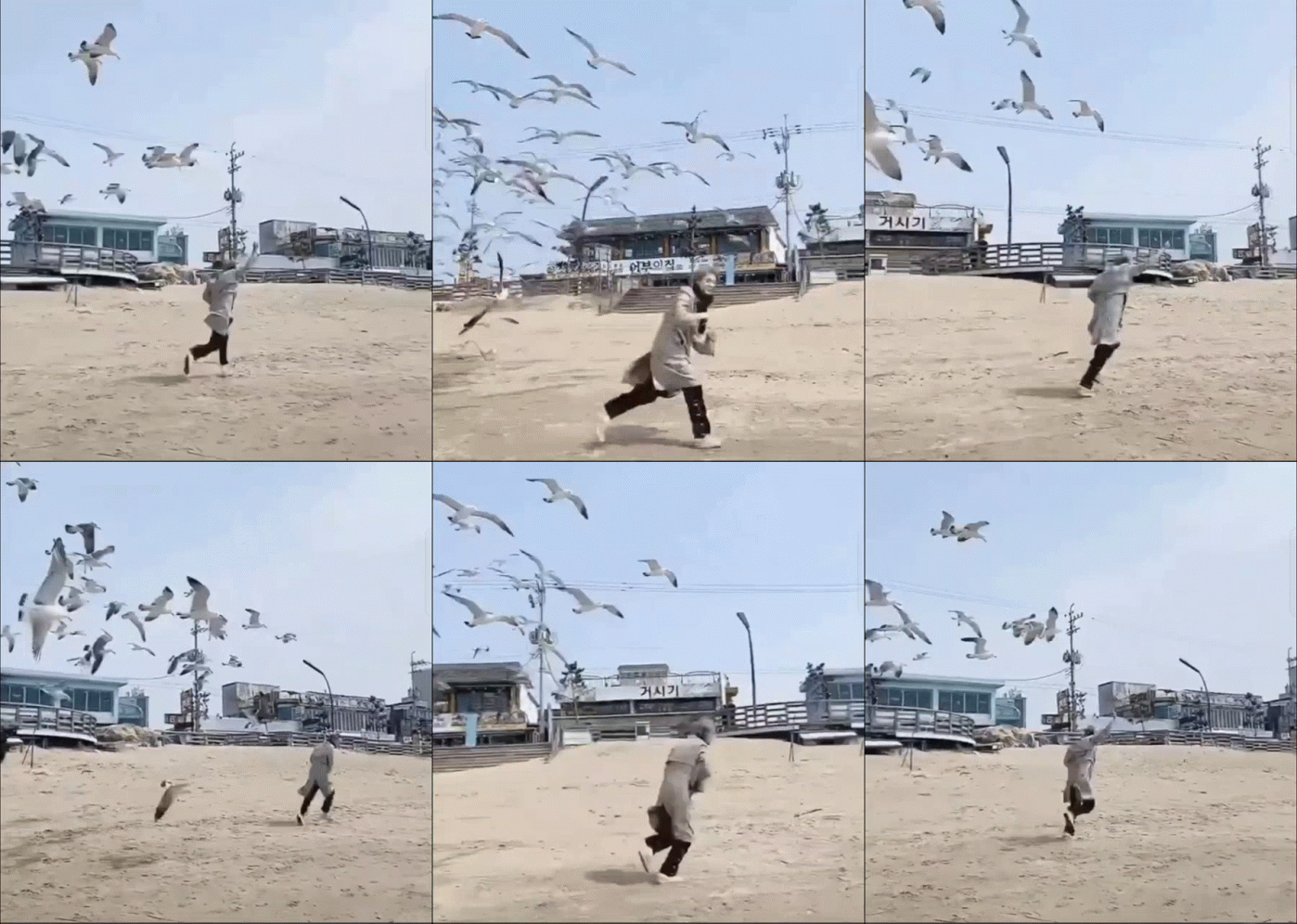
Astro Astro Kpop GIF
ALT: Astro Astro Kpop GIF
media.tenor.com
New preprint by @bsiepe.bsky.social & our WARN-D lab. We collected information on sleep, tiredness & stress with both EMA and sensor data, and try to find out to which degree these are associated contemporaneously in a large dataset (n~800) with many timepoints (t~360). Brief 🧵

Paper alert: across 10k participants & 36 versions of the emotional dot probe task, task *reliability* cannot be distinguished from 0 (!). Raises very serious questions about the literature (how did so many find positive relations between this task and other variables). #PsychSciSky

No Evidence of Reliability Across 36 Variations of the Emotional Dot-Probe Task in 9,600 Participants - Irene Xu, Eliza Passell, Roger W. Strong, Elizabeth Grinspoon, Laneé Jung, Jeremy B. Wilmer, Lau...
The emotional dot-probe task is a widely used measure of attentional bias to threat. Recent work suggests, however, that subtraction-based behavioral measures o...
journals.sagepub.com
Journals are really getting brave with these damn two-week review deadlines... #Academia #Publishing
Haven't posted here yet since joining, so here it goes: I am a psychologist/cognitive neuroscientist with a focus on developing predictive models and connecting lab and real-life assessments. An example is my first PhD Paper, where we use lab-based arousal measures for real-life stress detection 1/n

