

Nicolò Baggi
@nibaggi.bsky.social
Postdoc @UniversitéParisCité 🇫🇷 | previously @UPC & @ICMAB-CSIC 🇪🇸 | PhD @UniversitéParisSaclay 🇫🇷 | into photoswitches 💡🧪 and energy storage 🔋 ORCiD: 0000-0003-4743-5151

Totally excited to share our newest all visible and NIR-light rewritable four-colour systems enabling all natural color 2D and 3D displays! Huge milestone for all-photonic multi-responsive materials: check it out at: chemrxiv.org/doi/full/10....

Read about - Fluorescent merocyanines: from fundamental properties to applications as molecular probes, in bioimaging and as emissive dye aggregates. Now in Chem Soc Rev. 😎 pubs.rsc.org/cs/article/d...
Submit This Form
pubs.rsc.org

Endo-selective [2+2] cycloaddition of norbornadienes enables the synthesis of homocubanes #chemsky

Endo-selective [2+2] cycloaddition of norbornadienes enables the synthesis of homocubanes
Nature Chemistry, Published online: 10 July 2026; doi:10.1038/s41557-026-02201-xThe [2+2] cycloaddition of norbornadienes and alkynes usually favours the formation of the exo adducts. Now, a nickel-catalysed endo-selective [2+2] cycloaddition has been developed, which has been used to generate otherwise elusive endo-tricyclononadienes, and further derivatized via intramolecular [2+2] photocycloaddition to synthesize homocubanes.
dlvr.it
Serendipitous twist in a hemithioindigo molecular motor enables energy storage #chemsky

Serendipitous twist in a hemithioindigo molecular motor enables energy storage
Nature Chemistry, Published online: 29 June 2026; doi:10.1038/s41557-026-02191-wHemithioindigo-based molecular motors are driven by visible light and their rotation has been branded as ‘sunlight-powered’, but for a decade this ability has remained unexploited. Now, a subtle change in their structure leads to a serendipitous ‘supercharged’ intermediate, ready to store the Sun’s energy.
dlvr.it

I would classify myself generally as skeptical of review articles, but (with obvious bias) I am hopeful that this one is unusual, in a good way! We tried to put in one place a bunch of important ideas that have been driving the lab's thinking recently. pubs.acs.org/doi/10.1021/...

Shape-Conserving Atom Replacements
Recent advances have made possible the replacement of individual atoms within a molecular skeleton while preserving the integrity of the surrounding framework. These skeletal editing reactions are emerging as powerful tools for molecular optimization, as they directly mirror tactics central to structure–activity-relationship studies and therefore have the potential to accelerate progress in discovery chemistry settings. This review introduces a comprehensive framework for categorizing atom replacement reactions in aromatic systems, while also delineating strategies that enable these transformations. Important heuristics related to shape-conservation are discussed, including notions of skeletal rotation, introduction of vestigial substituents, and retrosynthetic simplicity. Examples of reactions which obey these principles are analyzed, focusing first on C-to-N replacement in aromatic systems (“benzene to pyridine” and related reactions) before moving to other classes of aromatic and aliphatic replacement reactions.
pubs.acs.org

📢Congratulations to Mila Miroshnichenko, new ICMAB PhD graduate!🎉 She is now going to do a postdoc at UPC! icmab.es/congratulati...


Ok chemsky here's the @gracegdhan.bsky.social paper in print, and I've been working with Chris Bickel for coming up on 20 years, but I think you'll all agree he outdid himself with the artistic concept of this cover!
 Science Magazine@science.org · 3mo ago
A new Science study highlights the potential of molecular solar thermal technology as a practical route toward scalable, on-demand heat delivery for water heating, cooking, and surface defrosting. Learn more in this week's issue: https://scim.ag/4tu9AwJ

Anyway here's the paper again www.science.org/doi/10.1126/...

Molecular solar thermal energy storage in Dewar pyrimidone beyond 1.6 megajoules per kilogram
Storing sunlight in a compact and rechargeable form remains a central challenge for solar energy utilization. Molecular solar thermal (MOST) energy storage systems, which harness photon energy and rel...
science.org
A new Science study highlights the potential of molecular solar thermal technology as a practical route toward scalable, on-demand heat delivery for water heating, cooking, and surface defrosting. Learn more in this week's issue: https://scim.ag/4tu9AwJ

The final program of hashtag#PEMM2026 has been published. Don't forget to apply for a poster ! All poster submissions will be accepted upon receipt until May 30. #InternationalCongress #Symposium #MolecularPhotonics #MolecularElectronics #MolecularMachines #CNRS #ENS #UCBL #NationalDay


Self-driving labs are transforming chemistry; but high cost & complexity limit access to a few well-funded labs. We wanted to change that. Our new paper in #NatureSynthesis introduces RoboChem-Flex 🧪🤖 🔗https://nature.com/articles/s44160-026-01053-0 #selfdrivinglab #flowchemistry #optimization


From our collection on photoluminescent organic materials... "Emissive organic crystals and device applications" by Shuai Zhao, Xue-Dong Wang and Hongbing Fu Read the full review here 👉

Emissive organic crystals and device applications
Emissive organic crystals represent a rapidly advancing frontier in materials science, offering a unique platform that merges the superior optoelectronic characteristics of crystalline order with high-efficiency light emission. This review comprehensively surveys the field, from the fundamental molecular design pri
pubs.rsc.org

Come and join my group at @oxfordchemistry.bsky.social! We have an opening for a postdoc position in photopharmacology. Prior experience with photoswitches and photopharmacology essential. Deadline 27th April. For more details see my.corehr.com/pls/uoxrecru... #Chemsky

Job Details
my.corehr.com

Our perspective charts the potential of water as a programmable reaction medium using compatible catalysts, EDA complexes, engineered micelles and microdroplets. Aqueous-phase organic photochemistry: Distinct modes and interfaces #ChemSky #photochemistry #watersoluble doi.org/10.1016/j.ch...


Fancy a career in scientific publishing? We're looking for an Associate/Senior Editor with expertise in device engineering to join the Nature Research Cross-Journal Editorial Team. Can be based in Shanghai or Pune. Closing date: April 15th. springernature.wd3.myworkdayjobs.com/SpringerNatu...

Exploring Spin-State Selective Harvesting Pathways from Singlet Fission Dimers to a Near-Infrared-Emissive Spin-Flip Emitter | Journal of the American Chemical Society pubs.acs.org/doi/10.1021/...

Exploring Spin-State Selective Harvesting Pathways from Singlet Fission Dimers to a Near-Infrared-Emissive Spin-Flip Emitter
Singlet fission (SF), a photophysical process generating two triplet excitons from one singlet exciton, has the potential to boost efficiency in photovoltaics and organic light-emitting diodes. Previous studies on energy-level control and intermolecular interactions have identified key factors for maximizing the efficiency of the initial SF process. However, in isothermic/endothermic SF systems, such as tetracene derivatives, the subsequent sensitization process becomes less efficient in the presence of a competing Förster resonance energy transfer (FRET) process. Here, we demonstrate that a molybdenum-based near-infrared light-emitting spin-flip emitter serves as a triplet-selective energy acceptor from triplet states of tetracene-based dimers generated by SF. The large energy gap existing between the spin-allowed transitions and the luminescent spin-flip transition of the molybdenum complex allowed efficient exothermic triplet energy transfer (TET) to the spin-flip excited doublet state of the complex while circumventing the FRET from the initially formed tetracene singlet state to the high-energy spin-allowed states of the complex. The quantum yields of the doublet state formation of the molybdenum complex by tetracene-based SF dimers with phenylene, 2,5-methylphenylene, and p-terphenylene bridging units were quantified to be 112 ± 6%, 132 ± 2%, and 128 ± 4%, respectively, in solution. The drop of fluorescence lifetimes of the SF dimers at high concentrations of the molybdenum complex implies energy transfer from exchange-coupled triplet pairs, highlighting the importance of controlling exchange interaction and triplet pair recombination. This work represents a significant step toward developing exciton/photon amplification materials by combining SF materials with transition-metal complexes, advancing the application of SF beyond conventional limitations.
pubs.acs.org

In @cp-chem.bsky.social tinyurl.com/3vmzatbh Maria @benjaminoacid.bsky.social @stefanborsley.bsky.social Fabio & @zashbridge.bsky.social show that driving a receptor out-of-equilibrium through chem fueling allows quantification of binding at concentrations where receptor is saturated at equilibrium😃

Out-of-equilibrium sensing with a chemically fueled molecular machine
Biological adaptive receptors are driven out of equilibrium to change the detectable range of analyte concentrations. Here, a chemically fueled rotaxane information ratchet couples Zn(II) binding to c...
cell.com
Back in 2019 I wrote my first grant, for the ACS PRF, in which I proposed carbon insertion into LSD (truly a pipe dream at the time). After teaming up with @nagiblab.bsky.social and @deolsonlab.bsky.social, the dream is finally a reality! www.sciencedirect.com/science/arti...

Skeletal editing by iron-catalyzed carbene insertion of trichloromethanes
Direct interchange between five- and six-membered nitrogen heterocycles by skeletal editing is valuable in drug discovery. Specifically, inserting a c…
sciencedirect.com

I defended my PhD 10 years ago today. That was the least remarkable thing that happened that day. Sharing something I wrote about it last year. Since then "the horrors persist but so do we." And with dignity.


Read about: Generating extended foldamer dye stacks and unravelling their evolving exciton dynamics - just published @natchem.nature.com! ✨ www.nature.com/articles/s41...

Generating extended foldamer dye stacks and unravelling their evolving exciton dynamics - Nature Chemistry
Synthetic dye-based analogues of biomacromolecules often rely on simple dimers to model solid-state photofunctional behaviour. Now an iterative block-based coupling protocol has been developed that ge...
nature.com

New prespectives on the potential of "Cationic diketopyrrolopyrroles as potent photosensitizers for the photodynamic inactivation of methicillin-resistant Staphylococcus aureus"🚀🔬🧪#chemsky

Cationic diketopyrrolopyrroles as potent photosensitizers for the photodynamic inactivation of methicillin-resistant Staphylococcus aureus
Diketopyrrolopyrroles (DPP) are a multifaceted family of organic dyes that have attracted considerable attention in optoelectronic applications due to…
sciencedirect.com

No research output is fine. You can mentor a ton of students through teaching failure. All the research outcomes with no mentoring of students is not fine. If you don't want to mentor students, and just want to do research, go to the private sector.
On the recent AI/student discourse (Science letter thingy), thought about a formal rebuttal, but others do it better. Briefly though, if you are not mentoring students in how to do research, you shouldn't be a professor at a research university. The research is a byproduct of the mentoring.

Sir James Dewar, Scottish chemist, would be nominated for the Nobel 8 times, but you probably know him for his most famous invention, which never made him a penny, developed to hold ultra-cold liquified gases. You probably own a "Dewar vessel," but you know it as a Thermos™. Let's talk about it.
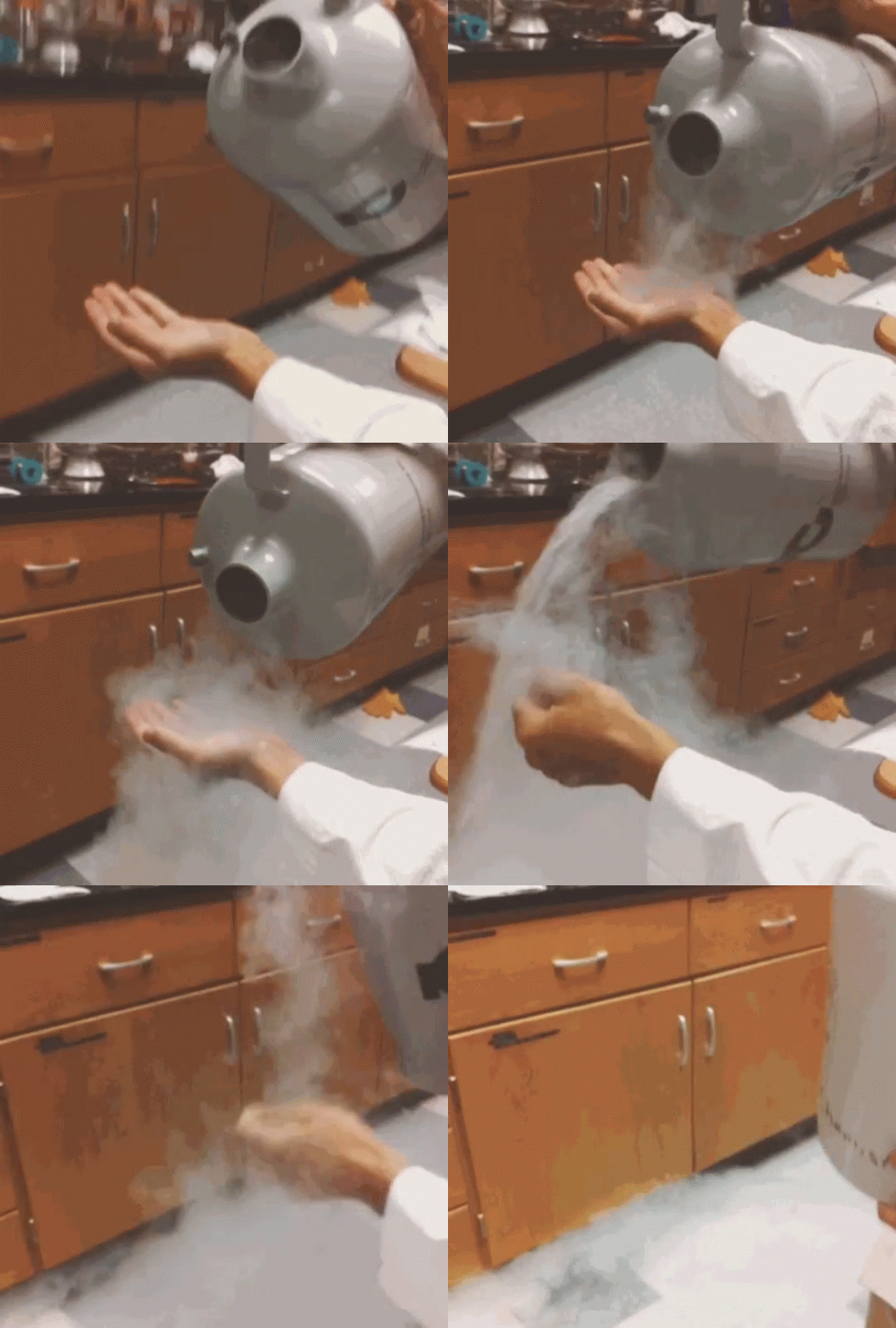
a person is holding a container over their head in a kitchen ..
Alt: a person is holding an insulated container of liquid nitrogen. They pour the liquified gas over an open human hand in a lab setting. The Leidenfrost effect prevents any serious injury, as the liquid boils off before transferring much heat.
media.tenor.com

On #InternationalWomensDay, here's another edition of Women in Chemistry History. This edition features women whose achievements in chemistry include the creation of synthetic emeralds, the impact of diet on intelligence and health, and more: www.compoundchem.com/2026/03/08/i... #ChemSky 🧪


Check out our latest in @acs.org ACS Energy Letters: Damon explores how #chirality may impact singlet fission and triplet fusion in molecular semiconductors as a new twist for efficient photon management, boosting performance of solarcells, displays and more. #OpenAccess pubs.acs.org/doi/10.1021/...

The Impact of Chirality on Singlet Fission and Triplet Fusion: A Molecular Twist for Photon Management
Chirality has recently emerged as a new means to profoundly impact the properties of organic semiconductors for spin-optoelectronic applications. Yet, a clear mechanistic understanding of chiral structure–property relationships remains absent to date, particularly for photon interconversion processes such as singlet exciton fission and triplet fusion. In this perspective, we highlight recent work that investigates chiral structures for these processes. We discuss the various ways in which chirality can impact such conversion processes and suggest ways to leverage it to improve photon management for both energy applications and quantum information science.
pubs.acs.org

Our manuscript on the redox- and protonation-chemistry of diboraheptacenes is published in @jacs.acspublications.org (pubs.acs.org/doi/full/10....)! @JinhyoHwang and @chemheechan report a DBH dianion (w/NIR absorption) that’s the longest fully conjugated boron-doped acene! #maingroup

Redox- and Protonation-Tunable Diboraheptacenes
Acenes are attractive molecular platforms with characteristic π-electron delocalization, resulting in exceptionally small HOMO–LUMO gaps, which makes them valuable for use in a variety of organic elec...
pubs.acs.org
Guest-Induced Activation of Multicolor Photoluminescence in Naphthalene Bisimide Liquid Crystals. Early View in Advanced Materials. advanced.onlinelibrary.wiley.com/doi/10.1002/...

Guest‐Induced Activation of Multicolor Photoluminescence in Naphthalene Bisimide Liquid Crystals
Supramolecular host–guest design in naphthalene bisimide liquid crystals activates charge-transfer emission and enables continuous tuning of color (511–685 nm) and lifetime, spanning prompt fluoresce...
advanced.onlinelibrary.wiley.com

Bonjour à toutes et à tous, Nous recrutons un·e enseignant·e-chercheur·euse contractuel·le en chimie des systèmes conjugués au laboratoire MOLTECH Anjou et au département de chimie de @univangers.bsky.social www.univ-angers.fr/fr/universit... N’hésitez pas à me contacter!
Recrutement d'un ou d'une enseignant·e-chercheur·e contractuel·le en Chimie Chimie Organique des Systèmes Conjugués Electro-déficients - Université Angers
univ-angers.fr