White matter reflects the childhood exposome
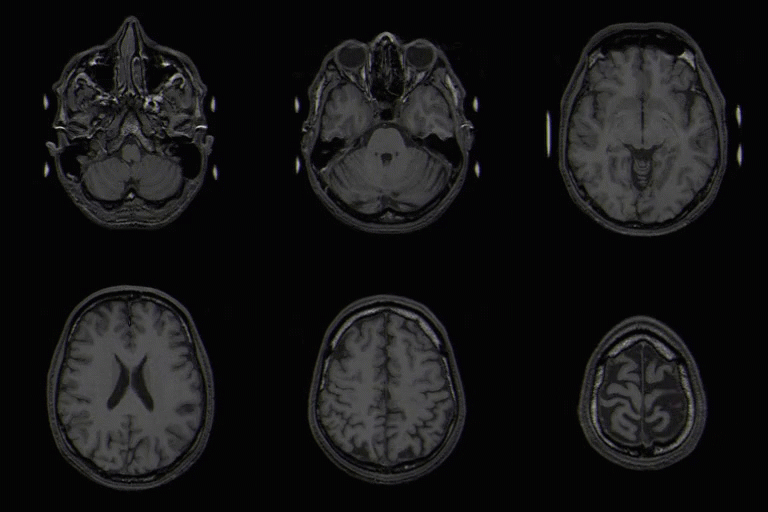
The childhood environment is critical for brain development. However, most neuroimaging studies examine individual environmental measures (e.g., socioeconomic status) or a limited set of exposures, obscuring how the combination of complex, real-world exposures jointly influence brain development. Here we investigated how white matter shape and tissue properties are linked to the childhood exposome, a multidimensional measure capturing over 300 environmental exposures. Using multi-shell diffusion MRI from 8,183 children (ages 9-10) in the ABCD study, we quantified microstructural and macrostructural properties across 62 person-specific white matter tracts. The exposome showed widespread and highly replicable associations with both white matter microstructure and macrostructure: more advantaged environments were associated with larger tract macrostructure and lower orientation dispersion. Principal component analysis revealed that the dominant axis of exposome-white matter covariation aligns with the cortical sensorimotor-association hierarchy, such that tracts spanning this hierarchy exhibit the strongest associations with the exposome. Multivariate models demonstrated that patterns of white matter features explained 25% of the variance in the exposome in unseen individuals. Notably, white matter-based prediction of cognition was markedly reduced after accounting for the exposome (~82% reduction in explained variance), indicating that brain-cognition associations overlap substantially with variance captured by the exposome. These findings generalized to independent data from the Healthy Brain Network (n=869), which differs substantially from ABCD in MRI acquisition, participant selection, and childhood environments. Together, these results suggest that white matter architecture strongly reflects the childhood environment. ### Competing Interest Statement A.A.B. has consulted for Octave Bioscience and holds equity in Centile Bioscience. RB is on the Advisory Board and holds equity in Taliaz Health. D.A.F. is a founder of Turing Medical. Any potential conflict of interest has been reviewed and managed by the University of Minnesota. D.A.F. is an inventor of the FIRMM Technology 2198 (FIRMM, real-time monitoring and prediction of motion in MRI scans, exclusively licensed to Turing Medical). Any potential conflict of interest has been reviewed and managed by the University of Minnesota. This research was supported by funding from the National Institutes of Health (T32MH019112 to S.L.M.; R37MH125829 to D.A.F. and T.D.S.; 2R01MH112847 to R.T.S. and T.D.S.; R01MH120482 to T.D.S.; 2R01MH113550 to T.D.S.; R01MH123550 to R.T.S; F30MH138048 to K.Y.S.; RF1MH121868, RF1MH121867, RF1MH126699, R01AG060942, U19AG066567, R01EY033628, and R01EB027585 to A.R.; R01MH134886 to R.B.; T32MH016804 and T32MH018951 to V.J.S; R01MH133843 to A.A.B.; F31MH136685 to J.B.). S.L.M. was supported by the Hartwell Foundation (S.L.M.); G.S. was supported by a postdoctoral fellowship from the Canadian Institutes of Health Research (CIHR). A.S.K. is supported by a NARSAD Young Investigator Award from the Brain and Behavior Research Foundation. M.D.H. was supported by the German Research Foundation (project number 572317568). LMS was supported by a NSF SBE Postdoctoral Research Fellowship (#2507497).
bit.ly


 Steven Meisler@stevenmeisler.com · 2w ago