
New from @m-meyer.bsky.social myself and team: osf.io/preprints/ps... We asked whether people in the general population endorsed misidentification-like delusions. They do! Surprisingly often.

Nick Smith
@neuronnick.bsky.social
Neuroscientist. postdoc at UPenn Betley Lab. eating, learning, and dopamine https://nicksmithneuro.com/
New from @m-meyer.bsky.social myself and team: osf.io/preprints/ps... We asked whether people in the general population endorsed misidentification-like delusions. They do! Surprisingly often.

Very excited to post our paper led by @daburke.bsky.social www.nature.com/articles/s41... where we uncover a simple mathematical rule underlying how brains learn that a cue predicts a reward. 1/26

Duration between rewards controls the rate of behavioral and dopaminergic learning - Nature Neuroscience
Cue–reward learning rate scales proportionally with the time between rewards. Consequently, learning over a fixed duration is independent of the number of trials. This challenges trial-based dopamine ...
nature.com

Great news from the Senate appropriations committee
 Jenna Norton@jenna-m-norton.bsky.social · last yr.
“To the scientists wondering if there will even be an NIH by the end of this administration: this committee’s resounding message is ‘yes.’ “We support you and we need you to stay here and keep this research going.”

Very excited to share my postdoc work- out now at PNAS! Learn more about how neurons facing chronic autophagic stress compensate by upregulating two secretion pathways Autophagic stress activates distinct compensatory secretory pathways in neurons | PNAS www.pnas.org/doi/10.1073/...
PNAS
Proceedings of the National Academy of Sciences (PNAS), a peer reviewed journal of the National Academy of Sciences (NAS) - an authoritative source of high-impact, original research that broadly spans...
pnas.org

Reminder: Nobel-prize winning PCR (1983), used in basically all genetic tech today, was only possible because of extremophile bacterium discovered in 1964 in Yellowstone funded by a small ~$80k NSF grant with no obvious application at the time. #science 🧪 www.richmondscientific.com/how-a-discov...

How a discovery in Yellowstone National Park led to the development of PCR - Richmond Scientific
A discovery in Yellowstone National Park led to the development of PCR, the gold-standard COVID-19 tests used to fight the global pandemic.
richmondscientific.com

Excited to present our study in @natneuro.nature.com: a deep brain pathway that triggers safety-driven movement—overriding needs like finding food or social contacts. A look into how the brain weighs deep instincts. Congrats to all and first author @nkrauth.bsky.social. shorturl.at/toYFN

A hypothalamus–brainstem circuit governs the prioritization of safety over essential needs - Nature Neuroscience
Animals need to adapt behavior to balance survival with fulfillment of essential needs. Krauth et al. identify neurons in the lateral hypothalamus that, when activated, prioritize survival over other ...
shorturl.at

Enrico’s flickers like a memory you’re not sure is yours. Somewhere up there, maybe, is grace, or just more fog. San Francisco, holding its breath.


Thrilled to share our latest preprint and first major project from the lab, where we show a mechanism for direct interoceptive input to the insular cortex. Work by the incredible @zhezhao2017 with help from many others including @stefanoberto83.bsky.social
 bioRxiv Neuroscience@biorxiv-neursci.bsky.social · last yr.
Direct interoceptive input to the insular cortex shapes learned feeding behavior https://www.biorxiv.org/content/10.1101/2025.05.13.653896v1

Check out our latest! Studies led by the amazing Megan Brickner - she finds really interesting patterns of dopamine signaling in the basolateral amygdala that report the emotional salience of sensory state transitions. These are largely non-associative, value-free signals, in contrast to classic DA.
bioRxiv Neuroscience@biorxiv-neursci.bsky.social · last yr.Basolateral amygdala dopamine transmits a nonassociative emotional salience signal https://www.biorxiv.org/content/10.1101/2025.05.15.654323v1

Excited to share our latest story: "The gut-brain vagal axis governs mesolimbic dopamine dynamics and reward events" 🎉. Big congrats to 1st author Oriane Onimus 💪 🥳 & many thanks to all those involved 🙏🙏. www.biorxiv.org/content/10.1...

The gut-brain vagal axis governs mesolimbic dopamine dynamics and reward events
Reward-related processes have traditionally been ascribed to neural circuits centered on the dopamine (DA) system. While exteroceptive stimuli, such as food and drugs of abuse, are well-established ac...
biorxiv.org

My survey class on the history of science is essentially about the social conditions required for science. The final lecture is always about how the US became the dominant nation for research in the 2nd half of the 20th century, and how it in retrospect it may be seen as an anomalous "Golden Age."
 Chris Bail@chrisbail.bsky.social · last yr.
After 21 years at my dream job, I’m very sad to announce my early retirement from the National Institutes of Health. My life’s work has been to scientifically study how our food environment affects what we eat, and how what we eat affects our physiology.


Research briefing: A textbook assumption about the brain’s most abundant receptors needs to be rewritten https://go.nature.com/3FDq3KZ

A textbook assumption about the brain’s most abundant receptors needs to be rewritten
Neuronal AMPA receptors previously assumed to be calcium impermeable are unexpectedly shown to transport calcium ions.
go.nature.com

Cutting funds for science and research will save you a penny on the dollar but may one day cost you a life that you love.


Exclusive: NIH appears to archive policy requiring female animals in studies www.thetransmitter.org/policy/exclu...

Exclusive: NIH appears to archive policy requiring female animals in studies
Such a shift would “put us back in the dark ages in terms of our science,” says neuroscientist Anne Murphy, who helped to formulate the original policy.
thetransmitter.org

1/ 🧠 Excited to share our new preprint: Convergent state-control of endogenous opioid analgesia We uncover how cognitive + contextual factors—like injury, fear, and placebo—modulate pain through dynamic opioid signaling in the periaqueductal gray (PAG) biorxiv.org/content/10.1...


The Senate Committee on Health, Education, Labor, and Pensions, led by Senator Bill Cassidy (R-LA) - a gastroenterologist with an MD from LSU, just released a report entitled NIH IN THE 21st CENTURY: ENSURING TRANSPARENCY AND AMERICAN BIOMEDICAL LEADERSHIP. Since he is the ranking Republican, 1/n

The John Le Carré Advent Calendar - My cartoon for this week’s @theguardian.com Books. (with apologies to @realjohnlecarre.bsky.social and @harkaway.bsky.social)


Signals are in the red. www.nytimes.com/2024/12/01/h...

Long a ‘Crown Jewel’ of Government, N.I.H. Is Now a Target (Gift Article)
The agency long benefited from broad bipartisan support. But Republican criticism has intensified, and new choices for top health posts hope to upend the organization.
nytimes.com

Dear gut/brain neuroscientists -- is there a paper you'd consider groundbreaking in this field in the past ~10 years or so? Like, something that really changed how we thought about the gut/brain connection?

Just in time for Thanksgiving, we're grateful for the publication of our paper in #eLife doi.org/10.7554/eLif... We measured dopamine and behavioral responses to intraorally delivered sucrose across acquisition and extinction of a conditioned taste aversion. 1/n
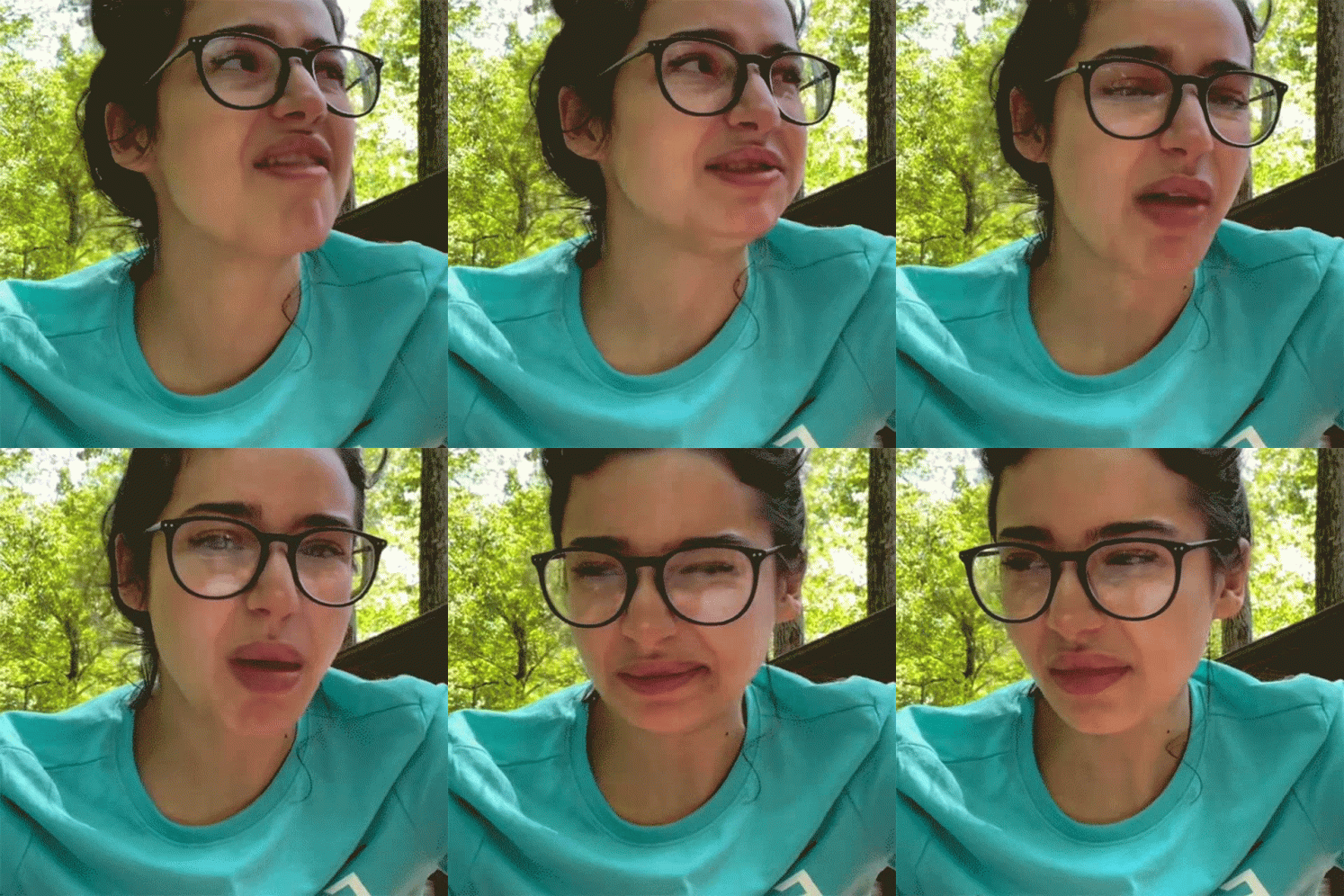
It Tastes Bad Melissa GIF
ALT: It Tastes Bad Melissa GIF
media.tenor.com

How the #brain talks to the #gut and vice versa! 🧪🧠💩 Check out the great primer on gut-brain communication and #interoception by @amberalhadeff.bsky.social and Nilay Yapici 👇👇👇 www.cell.com/current-biol...


My paper is out!! 🎉 "Opponent control of reinforcement by striatal dopamine and serotonin", @Nature Here, we show that dopamine and serotonin signals form a gas-brake system for reward in the mammalian brain THREAD ⬇️ 1/n

As a kid, I put a sample of pond water on a slide using a little microscope I got for my birthday. To my surprise I found a stentor attached to a speck of green. Seeing that little microscopic life form churning away helped spark my interest in biology. Cool to see how it works!
 Wallace Marshall@wallaceucsf.bsky.social · 2y ago
Single cells can learn without a brain, but how? Our new preprint from @deeparajan.bsky.social describes a model for habituation in Stentor coeruleus, based on receptor internalization and recycling, along with new experiments inspired by the model. 1/n www.biorxiv.org/content/10.1...


🌟 Cai Lab Nature (@natureportfolio.bsky.social) paper alert! In work led by Joe Zaki, we find that rest periods after learning not only stabilize new memories BUT ALSO integrate new memories with older ones from days past! (1/10) Read it here: www.nature.com/articles/s41...


OPEN RANK #FACULTY #POSITION in #Pharmacology & #Neuroscience with expertise in #behavioral pharmacology/neuroscience of relevance to substance use disorders. Review of applications will start immediately. Target start date is Fall 2025. Come join us! Apply here: careers.umich.edu/job_detail/2...
Professor / Associate Professor / Assistant Professor | U-M Careers
careers.umich.edu
I've been attending the Society for the Study of Ingestive Behavior (SSIB.org) conference since 1996 as a grad student, pdoc, prof and I now have the honor of serving as its President. Its an exceptionally warm group of scientists. Join us in Oxford UK on July 28 for the 2025 meetng!
Front End
ssib.org
 thewilliamslab@thewilliamslab.bsky.social · 2y ago
I made a starter pack for the Society for the Study of Ingestive Behavior #SSIB for all interested in being a #SSIBling. Please let me know if you would like to join the starter pack! go.bsky.app/8Zvp83e

Too often we spend only two weeks choosing a problem and then many years trying solving it, but this limits our potential impact. A must read for PhD students: Problem choice and decision trees in science and engineering. pubmed.ncbi.nlm.nih.gov/38608651/

NIH funding drives a massive amount of economic activity in the US, with 47 states experiencing over $100 million annually and 23 states experiencing over $1 billion annually.

 Nicole Rust@nicolecrust.bsky.social · 2y ago
Terrific piece summarizing a recent report: Every dollar of NIH research funding doubles in economic returns www.fiercebiotech.com/research/rep...
Happy to be here and excited to share my postdoc work, "Autophagic stress activates distinct compensatory secretory pathways in neurons" Now on BioRxiv www.biorxiv.org/content/10.1... Many thanks to @erikaholzbaur.bsky.social and @asapresearch.bsky.social
